
Enterprise CIOs are under constant pressure to modernize infrastructure, improve resiliency, support growth, and enable new initiatives without meaningful increases in budget. For many organizations, the answer is not finding new capital. It is uncovering the budget already hiding inside their telecom and network services environment.
CIOs today are expected to do more than ever. They are asked to support cloud transformation, strengthen security, improve network performance, and prepare their organizations for AI and automation initiatives. At the same time, CFOs are demanding tighter cost controls, stronger accountability, and clearer returns on every investment.
That creates a structural challenge for enterprise IT leaders:
How do you fund IT cost optimization and transformation when no new budget exists?
For many organizations, the answer begins with a more disciplined IT cost optimization strategy—one that starts by identifying hidden waste, billing errors, contract misalignment, and underused services across telecom and network services.
The CIO Budget Paradox: Transform Without New Spend
Modernization is no longer optional. Whether the priority is network resiliency, operational agility, cloud readiness, or better support for distributed locations, enterprise organizations need infrastructure that is aligned to business goals.
But many CIOs are facing a budget paradox. Business leaders want transformation. Finance leaders want cost discipline. Internal teams are already stretched thin. That often leads to delayed initiatives, partial modernization, or projects that never get funded at all.
What gets missed in this discussion is that many enterprise environments are carrying years of accumulated inefficiency inside telecom and network services. Those costs are often accepted as fixed when they are anything but fixed.
The Hidden Costs in Telecom and Network Services
Across enterprise environments, costs rise when invoices, contracts, and inventory do not align. The result is often a combination of overbilling, unused services, outdated pricing, fragmented carrier relationships, and missed leverage in renewals and negotiations.
This is especially common in organizations that have grown through acquisition, changed leadership, inherited decentralized service environments, or simply lacked the internal time to normalize years of billing and contract data.
Many organizations do not have a complete, sourceable inventory by carrier, location, and service type. Without that foundation, it is difficult to know what is in service, what is still under contract, what is being billed incorrectly, and where optimization opportunities truly exist.
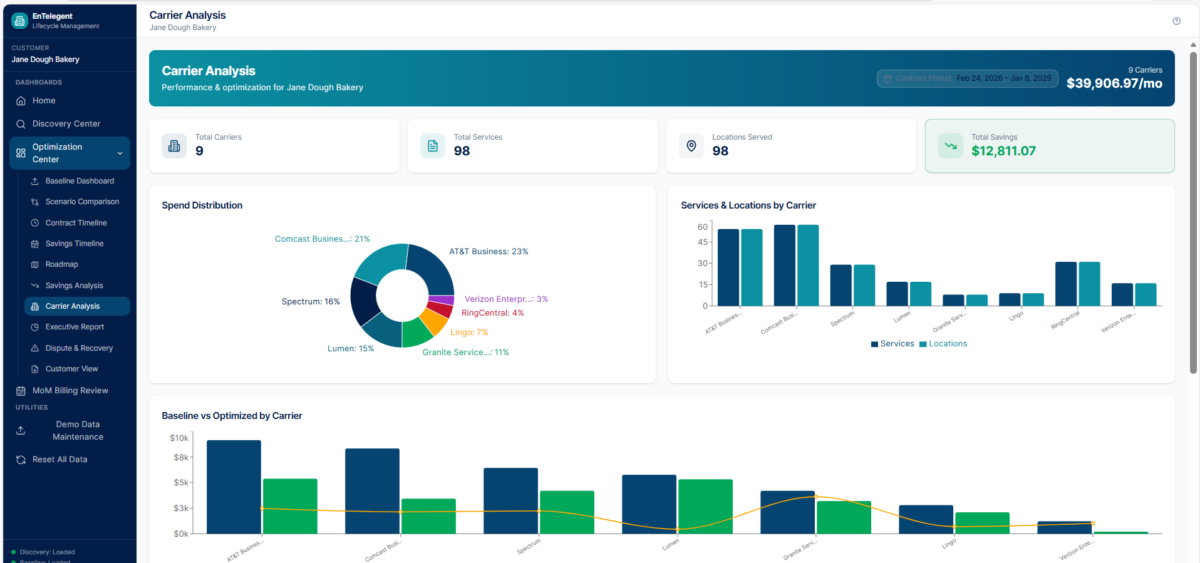
Caption:
Illustrative example of carrier-level analysis used behind the scenes to identify pricing inconsistencies, contract gaps, and optimization opportunities across telecom and network services.
Note:
Illustrative examples shown. Access to analytics and reporting tools varies by engagement model.
Why IT Cost Optimization Efforts Stall
Most internal teams understand there may be savings in the environment. The challenge is execution.
Data is fragmented across invoices, contracts, service records, carrier systems, and internal spreadsheets. Even when a TEM platform is in place, inventory may still be incomplete, outdated, or disconnected from contract terms and actual usage.
Internal teams may not have the time to reconcile thousands of line items, validate billing errors, benchmark pricing, and pursue contract improvements while also running day-to-day operations.
This is where many cost optimization efforts lose momentum. The problem is not awareness. The problem is the lack of a trusted baseline and the internal lift required to act on it.
A New Model: Performance-Based Cost Optimization
For CFOs and CIOs alike, one of the most compelling shifts in this space is the move toward performance-based cost savings models.
Rather than requiring a large upfront consulting fee or a disruptive vendor change, a performance-based approach aligns payment to validated, executed results.
In the case of EnVision Shared Savings, developed by EnTelegent Solutions, the model is simple:
No Savings = No Cost.
That matters because it changes the conversation. Instead of asking leadership to approve another speculative initiative, CIOs can bring forward an approach that is tied directly to measurable savings, improved visibility, and low internal burden.
From Cost Recovery to Transformation Funding
A well-executed telecom and network services cost management initiative does more than reduce expense. It can create a funding source for broader modernization.
When organizations identify billing errors, eliminate unused or duplicate services, benchmark rates, improve contract terms, and evaluate high-cost legacy services, they often unlock meaningful savings.
These savings can then be redirected into strategic priorities.
For enterprise organizations, this is the shift:
Cost optimization becomes a funding mechanism—not just a cost reduction exercise.
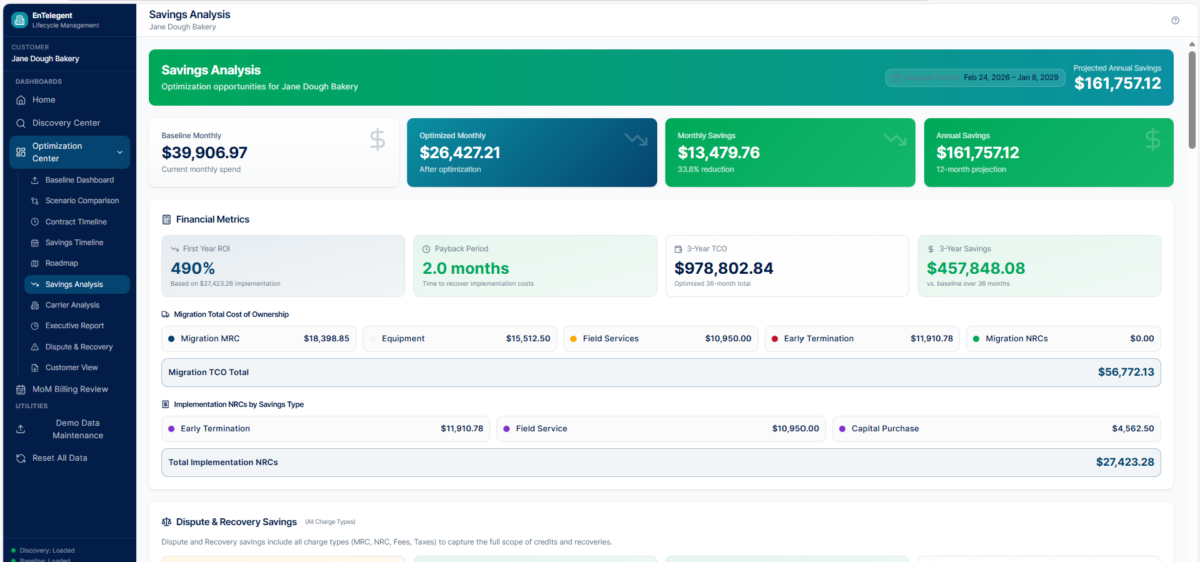
Caption:
Illustrative example of how savings opportunities can be quantified, including projected savings, ROI, and financial impact across telecom and network services.
Note:
Illustrative examples shown. Access to analytics and reporting tools varies by engagement model.
Real-World Examples of Network Cost Optimization
The value of this approach becomes clear when organizations move from fragmented data to actionable insight.
A global financial technology provider, following years of acquisition-driven growth, lacked visibility into its telecom and network services environment. Despite having existing tools, inventory gaps and fragmented contracts limited their ability to optimize spend.
The result:
-
$3.5 million reduction in monthly telecom spend
-
Recovery of billing errors and elimination of unused services
-
Stronger vendor contracts and improved visibility
In another example, a regional healthcare organization facing rapid expansion and network complexity:
-
Achieved a 24% reduction in monthly network costs
-
Improved contract visibility and pricing
-
Developed a WAN modernization roadmap aligned with savings
These outcomes highlight a consistent pattern:
Clarity creates control. Control creates savings. Savings fund transformation.
Why This Matters for CIOs and CFOs
For CIOs, this approach delivers more than cost reduction. It creates a trusted, sourceable inventory and provides better inputs for modernization decisions. It enables leaders to align infrastructure with business goals, identify inefficiencies, and act with confidence.
For CFOs, the impact is equally compelling:
-
Hard-dollar savings and recovered credits
-
Improved EBITDA (Earnings Before Interest, Taxes, Depreciation, and Amortization)
-
Better financial visibility
-
No upfront financial risk
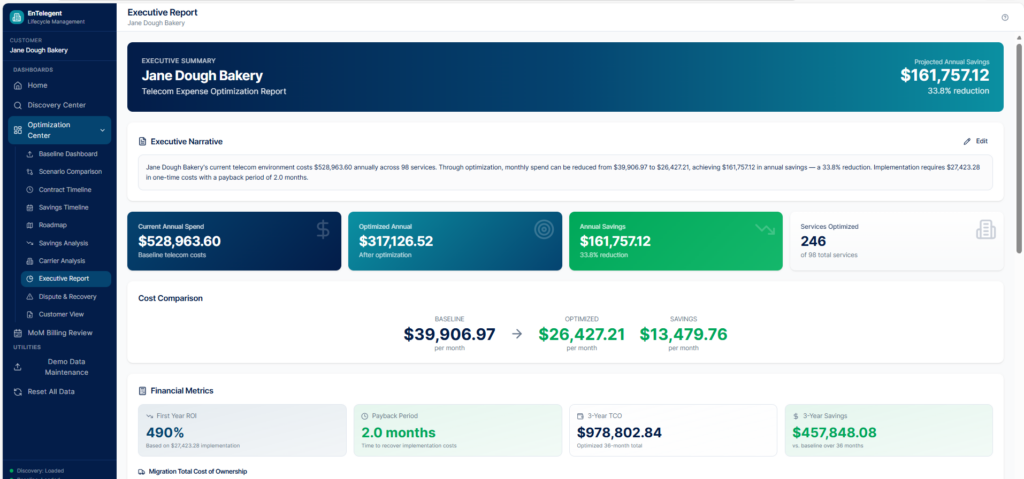
Caption:
Illustrative executive-level reporting that translates telecom and network services analysis into financial and operational insights.
Note:
Illustrative examples shown. Access to analytics and reporting tools varies by engagement model.
The Most Overlooked Advantage: Minimal Internal Lift
One of the biggest reasons enterprise optimization initiatives fail is not lack of opportunity. It is the amount of effort required to pursue them.
When the process depends heavily on internal teams, even strong opportunities can stall.
A performance-based approach like EnVision Shared Savings addresses this directly:
-
External teams handle data normalization, audits, and execution
-
Internal teams provide access—not heavy lift
-
Existing vendor relationships remain intact
The result is meaningful financial and operational impact without disrupting internal priorities.
A Smarter Way to Fund IT Transformation
The real question for enterprise IT leaders is no longer just how to reduce cost.
It is how to free up funds for higher-value initiatives.
When CIOs and CFOs adopt a disciplined, performance-based approach to telecom and network services optimization, they gain more than savings. They gain visibility, leverage, and a practical path to fund modernization.
That is the opportunity behind EnVision Shared Savings.
It is not just about cutting expense.
It is about creating the financial room to move forward.
Download the EnVision Shared Savings CIO & CFO Brief for a deeper executive overview, or work with your Technology Consultant to request an EnVision Shared Savings review.